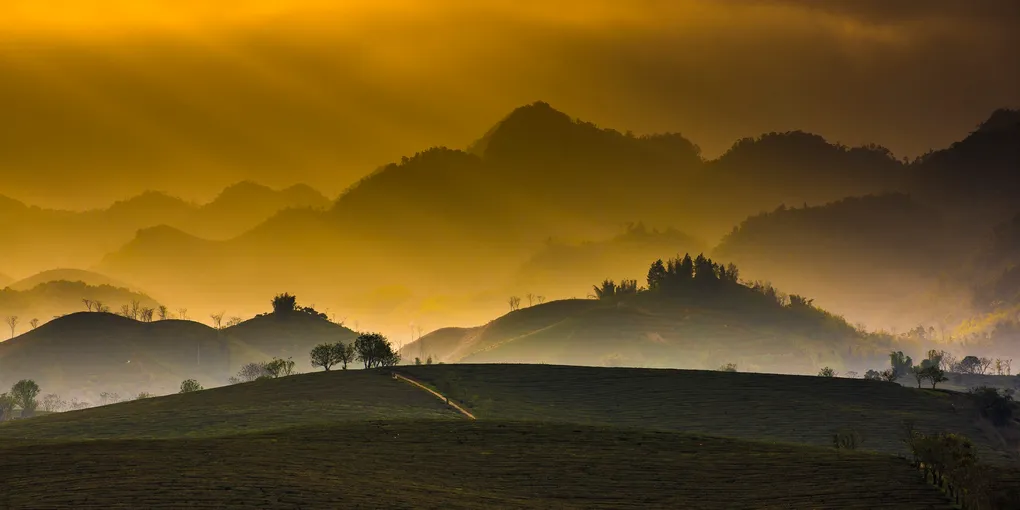
Come early, before the sun has cleared the ridges, and the plateau has no edges. Fog lies in the hollows between the hills like milk left standing in a bowl, and the tea bushes come out of it row by row, each row a dark stitch following the curve of the slope. Nothing moves but the fog. Then the light finds the tops of the hills, the white thins to gold, and you can see what the fog was hiding: not wilderness, but a farm, a hundred hills of it, combed by hand.
That is the thing to understand about Mộc Châu before you go. It is a highland in Sơn La province, roughly 1,000 to 1,050 metres up and around 190 kilometres west of Hà Nội along National Route 6, and its loveliest sights are almost all crops. The tea is a crop. The plum orchards that whiten the valleys before Tết are a crop. The fields of white mustard flowers that people drive up for in early winter are a crop. Even the plateau’s most famous product, its milk, comes from a state farm that army veterans began clearing in 1958, the origin of today’s Mộc Châu Milk. The landscape is beautiful the way a well-kept garden is beautiful: because someone works it every day.
Read the calendar, not the brochure
Once you see Mộc Châu as a farm, its seasons make sense, and so do its disappointments. Flowers arrive when the planting does, and they shift by a few weeks from year to year.
Late October into November belongs to the dã quỳ, the wild sunflowers that flare yellow along the roadsides and around the tea hills. From about November into December the white mustard (cải trắng) comes into flower, and the fields look as if a light frost has settled and refused to melt. Late January to mid-February is plum blossom, best in the valley of Nà Ka, about 16 kilometres from the old farm town, where whole slopes go white under the bare branches. By May and June those same trees are heavy with mận hậu, the sour-sweet plums sold in baskets along the highway. Between the blooms, the tea stays green all year, which is why it is the one sight you can count on.
The honest corollary: a photograph you saw online was taken in a particular week, in a particular field, often someone’s private one. Arrive a fortnight late and the mustard has gone to seed. Arrive on a Saturday and you will share the field with half of Hà Nội. Many flower plots and viewpoints charge a small fee to walk in and take pictures. That is fair enough; it is their crop.
The tea, the falls and the bridge
Start with the tea. The heart-shaped tea hill in the Tân Lập area is the famous one, a hill whose rows curve around a dip that, seen from above, looks like a heart. Entry is free or close to it, though some sources mention a small fee. It is lovelier at dawn or in late afternoon, when the light rakes across the rows and picks out every ridge. But any of the surrounding tea hills will do the same thing to the light, and most of them are emptier.
Dải Yếm waterfall, also called Thác Nàng, the Maiden’s Falls, drops about 100 metres in two sections in Mường Sang commune. The name means “the bodice strap”, and after rain the water does fall in long pale ribbons down the rock. In the dry months it thins considerably.
Then there is the Bạch Long glass bridge, which Guinness World Records certified in 2022: 632 metres of glass walkway, about 150 metres above the valley floor at its highest. It is a commercial attraction, ticketed and busy, and it is exactly as vertiginous as it sounds. Go if you like heights. Skip it without guilt if you came for the quiet.
Practical notes
- Getting there: about 190–200 km from Hà Nội on National Route 6, via Hòa Bình and the Mai Châu valley. Buses and limousine vans leave from Mỹ Đình, Yên Nghĩa and Giáp Bát; allow four to five hours. By motorbike, five to six. The Hòa Bình–Mộc Châu expressway is under construction, and the Sơn La section is not expected before 2027, so don’t plan around it.
- How long: two nights. One dawn for the tea hills, one day for the falls, the orchards or the bridge.
- When to go: late October to December for wild sunflowers and white mustard; late January to mid-February for plum blossom; May–June for plums and a cool escape from the lowland heat. Winter nights are properly cold, and frost can settle on the hills, so pack a warm layer.
- What to eat: bê chao, young veal blanched, marinated and flash-fried, served with a sweet-sour dipping sauce, is the local signature. Buy fresh milk, yoghurt and bánh sữa (milk sweets) from the dairy shops in town, and plums in season.
- Where to stay: a farmstay or homestay among the tea hills rather than on the highway through town. The trucks on Route 6 run late.
- Downsides: weekend crowds from Hà Nội; flower timings that vary by weeks; paid photo spots; the long, truck-heavy drive. Go midweek if you can.
- Addresses: after the 2025 administrative reforms the old Mộc Châu district and town were reorganised into wards and communes such as Mộc Châu, Mộc Sơn, Thảo Nguyên and Vân Sơn, so older guides’ addresses may not match the signs.
Go back, before you leave, to a tea hill at first light. The fog will be in the hollows again, the rows surfacing one by one, and in the picking months there may already be someone among them in a conical hat, working. The plateau was planted for that person, not for you. That is exactly why it is worth the trip.
Cover photo: mist over the Mộc Châu tea hills by Linh Pham, CC0, via Wikimedia Commons.
