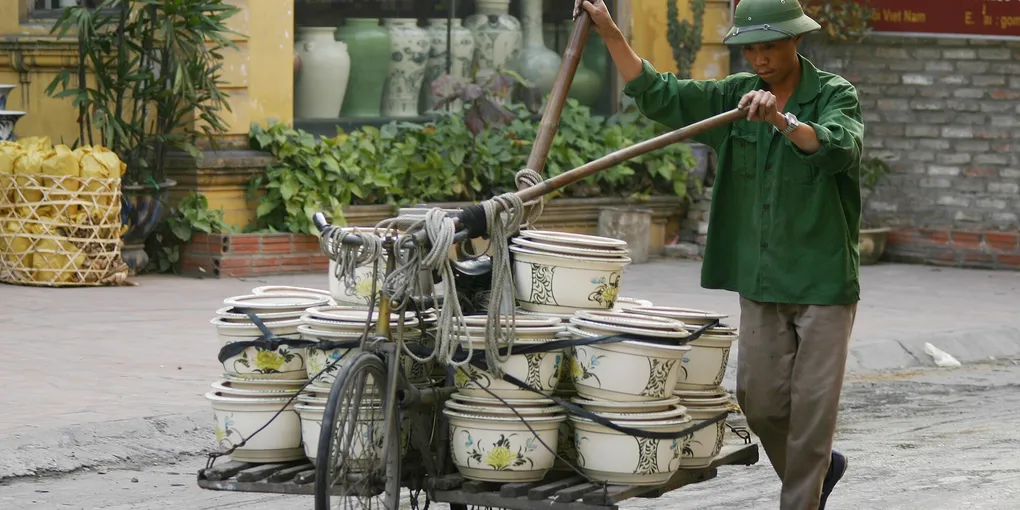
A man in a green pith helmet leans into the handlebars of a bicycle that no longer has room for a rider. Glazed planters are lashed to it in towers, cream bodies painted with yellow flowers and blue scrolls, bound with rope and black rubber straps. Behind him a shop window is lined with vases. He is pushing six centuries of habit down the street, one load at a time.
That is the photograph at the top of this page, taken in Bát Tràng in January 2005. The village sits on the left bank of the Red River, a short ride downstream from the centre of Hà Nội. It has made pots for so long that its name is itself about crockery: bát is the everyday Vietnamese word for a bowl, and village tradition remembers an older name, Bạch Thổ phường, the ward of white clay.
A guild that came upriver
How the potters got here is a story the village tells about itself, and it should be heard as one. The tradition, repeated in the village and in the national press, holds that when Lý Thái Tổ moved the capital to Thăng Long in 1010, potters from Bồ Bát, in what is now Yên Mô district of Ninh Bình, followed the court north. They found white clay on the river bank and opened kilns for bricks and bowls. Several clans, usually named as Trần, Vương, Nguyễn, Lê and Phạm, are remembered as the founders. Other accounts place Bồ Bát in Thanh Hoá, or date the name Bát Tràng only to the fifteenth century. No document from 1010 survives to settle the matter.
The village kept its own memory anyway. A couplet at the đình, the communal house where the village honours its guardian spirits, begins Bồ di thủ nghệ: the craft was carried here from Bồ.
What the paper record can show is later and firmer. Under the Trần a commune called Bát Khối appears, joining Bát Tràng with neighbouring Thổ Khối. In the fifteenth century the scholar-official Nguyễn Trãi, in his geography Dư địa chí, wrote plainly that Bát Tràng village made cups and bowls, and listed what it owed as tribute: seventy sets of bowls and plates. Excavations and museum collections take Bát Tràng wares back to the fourteenth century. In 2023 the National Museum of History in Hà Nội laid out its holdings century by century, from the fourteenth through the twentieth.
Names fired into the glaze
The sixteenth and seventeenth centuries are when Bát Tràng began to sign its work. Big altar pieces, such as incense burners, candle stands and tall vases with dragon handles, were made to order for đình, pagodas and temples, and many carry inscriptions in Chinese characters or Nôm. These give the date, the donor and sometimes the potter. Some donors were from the Mạc court. The Vietnamese encyclopaedia names a Princess Phúc Tràng and the general Mạc Ngọc Liễn among them. On the potters’ side, one family can be traced through the inscriptions: a man named Đỗ Phủ, his wife Nguyễn Thị Bền, their son and their daughter. In all, around thirty Bát Tràng potters are known by name. A lampstand dated by its inscription to 1637 now stands in the Guimet Museum in Paris.
This is rare. Most pre-modern pottery anywhere is anonymous. In Bát Tràng a wife and a daughter wrote their names into the clay before it went into the fire, and the fire kept them.
The glazes tell the rest. There is men lam, cobalt blue under a clear glaze. There are brown glazes and a jade-green men ngọc, and above all the ivory crackle, men rạn, whose surface crazes into a fine net of lines as it cools. The ceramics historian writing for Vietnam Heritage states that crackled ivory pieces were made only at Bát Tràng, from the sixteenth to the early seventeenth century. A village legend credits the crackle to Hứa Vinh Kiều, one of three envoys said to have learned pottery secrets on a mission to China. Treat that as a story that explains a glaze, not as a recipe’s provenance.
Downriver to the world
The Red River carried the wares as well as the potters. Bát Tràng sat between Thăng Long and Phố Hiến, the river port where foreign merchants were made to trade, and that position mattered. While the Ming restricted China’s own maritime trade, Vietnamese ceramics filled gaps across Southeast Asia, and the Dutch East India Company shipped them on to Southeast Asian markets and to Japan. When the Qing lifted China’s sea ban in 1684, cheaper Chinese porcelain returned and the export boom faded. The village turned back to its home market: altar ware, tableware, and bricks.
The bricks earned a line of folk verse still quoted today, a roll-call of the best things each place made:
Chiếu Nga Sơn, gạch Bát Tràng, Vải tơ Nam Định, lụa hàng Hà Đông.
Sedge mats from Nga Sơn, bricks from Bát Tràng, silk cloth from Nam Định, fine silks from Hà Đông.
Bát Tràng no longer makes bricks. The verse has outlived the product.
Clay, water, fire
The white clay that founded the village did not last. Its own deposit was worked out by the eighteenth century, and potters began bringing clay from Trúc Thôn and Hồ Lao in Đông Triều, in today’s Quảng Ninh. The clay is not used as dug. It is soaked and settled through a series of tanks, sometimes for months, until only the fine body remains.
The fire changed more than the clay. Village histories describe a line of kilns, each larger than the last: the low lò ếch, or frog kiln; then the lò đàn in the nineteenth century; then the lò bầu, a row of gourd-shaped domes climbing one after another. The Bát Tràng Museum keeps one of these gourd kilns, long out of use. Later came compact coal kilns, and by the early 2000s Bát Tràng had become a byword for air pollution, a village of chimneys. From the mid-2000s, with support from a UNDP energy project, households began switching to gas-fired shuttle kilns. By 2010 the trade press was describing a commune set on retiring coal kilns altogether.
The village today
Bát Tràng is now a commune of the capital, with an industrial cluster set apart from the houses and a pottery market for visitors. The craft is on Vietnam’s national list of intangible heritage. In December 2024 the village festival joined it, with its incense offerings, palanquin processions and the Cấp thủy and Nhập thủy water rites held at the đình.
The names on those seventeenth-century altar pieces have outlasted every kiln that fired them. One can picture the planters on that bicycle in 2005 sold and gone by evening. The clay they were made from had come a long way to reach the river.
Sources
- Bát Tràng porcelain — Wikipedia
- Bát Tràng — Wikipedia
- Gốm Bát Tràng — Wikipedia tiếng Việt
- Collection of Bát Tràng ceramics — Vietnam National Museum of History
- Vietnamese ceramics — Vietnam Heritage Magazine, August 2012
- Gốm cổ Bát Tràng “kể chuyện” — Nhân Dân
- Ký ức làng gốm Bồ Bát — Nhân Dân
- Lễ hội làng Bát Tràng là Di sản văn hóa phi vật thể quốc gia — Nhân Dân
- Bát Tràng thời hội nhập — Tạp chí Công Thương
- “Vua lò” đất Bát Tràng — Tạp chí Công Thương
- Gourd-shaped kiln no longer in use — Bát Tràng Museum, Google Arts & Culture
Cover photo: transporting ceramics at Bát Tràng (2005) by Steven C. Price, CC BY-SA 4.0, via Wikimedia Commons.
